

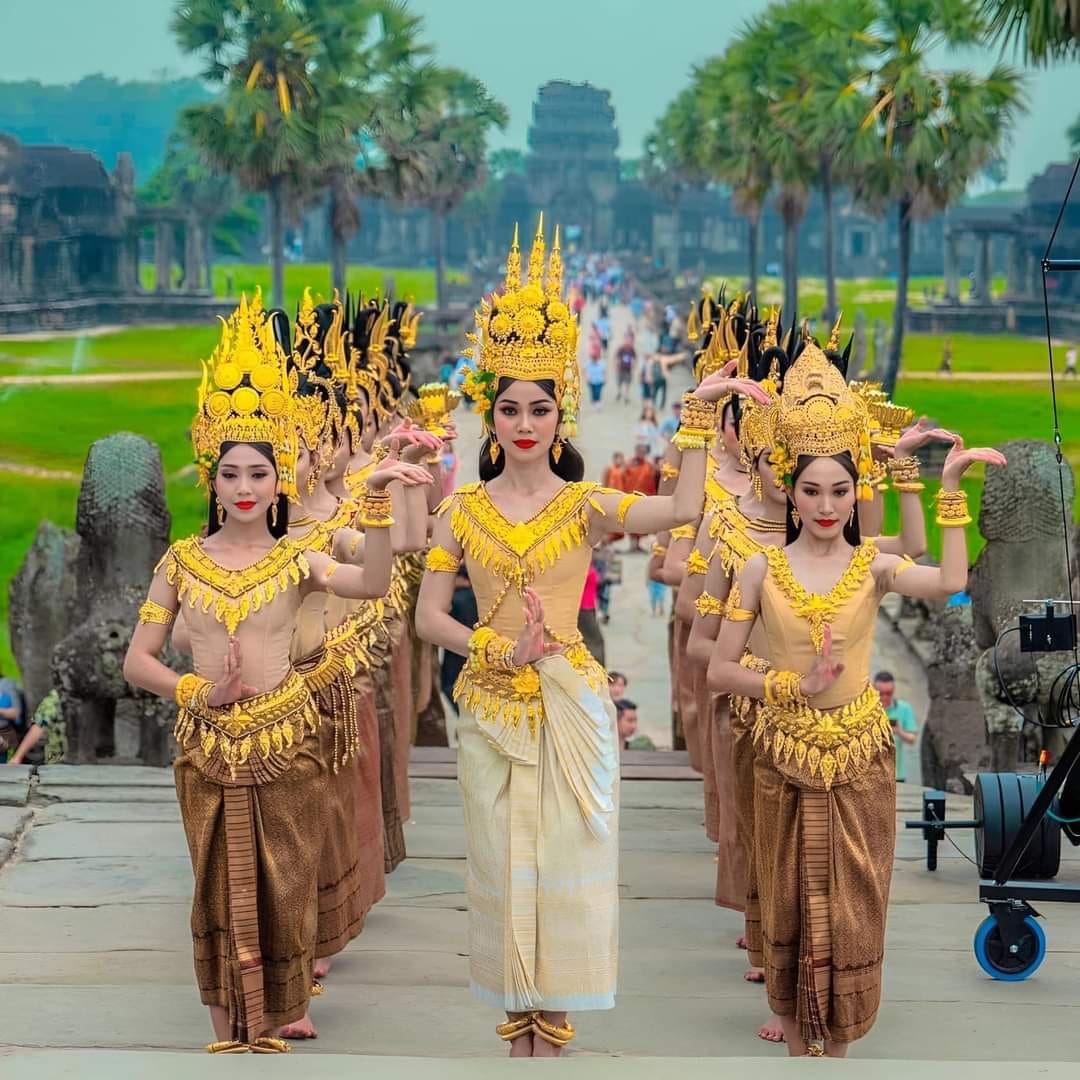
The classical Apsara dance traces its origins to ancient Hindu and animist traditions dating back to the 1st century CE. ItsnarrativemotifsarealsolinkedtotheepicRamayana.
During the Angkor Empire, from the reign of Jayavarman II to Jayavarman VII, the dance evolved into a distinctly Khmer form — with refined movements, a strict choreography, and deep symbolism. By the 13th century, it was regarded as an authentic Cambodian art rather than a derivative of Indian tradition.
Images of apsaras — celestial dancers in golden headdresses and silk garments — can be seen on the bas-reliefs of Angkor Wat and other temples. Depictions of three apsaras on the walls of King Jayavarman VII’s palace (12th century) are among the most iconic.
Over time, classical Khmer dance influenced the traditions of neighbouring Southeast Asian countries. As noted by Princess Bopha Devi, the cultural tradition of the Khmer Kingdom began forming as early as the 6th century, around 700 years before similar traditions appeared in Thailand.
The narrative foundation of the Apsara dance is rooted in Khmer mythology and the bas-reliefs of Angkor Wat depicting the Churning of the Ocean of Milk, where apsaras (celestial beings) and asuras (demons) rotate a giant naga in search of the elixir of immortality.
In one classical interpretation, the main heroine Mera, dressed in white as a symbol of purity, dances in her garden surrounded by apsara attendants scattering flowers — a sign of love for the people and the country.
Today, the Apsara dance is an integral part of the Royal Ballet of Cambodia.
Source: Ministry of Tourism of Cambodia